Pearson Edexcel · GCSE · Psychology
Course version: 1PS0 · Version from Sept 2017
Understand learning theories as an explanation of criminality, including…
Full specification wording
Criminal psychology: 6.1.1 Understand learning theories as an explanation of criminality, including strengths and weaknesses of each theory: • Operant Conditioning (Skinner, 1948), to include a. positive reinforcement b. negative reinforcement c. positive punishment d. negative punishment e. primary reinforcers f. secondary reinforcers • Social Learning Theory (Bandura, 1977), to include g. role models h. modelling i. identification j. observational learning k. vicarious reinforcement
Learning theories explain criminality as acquired behaviour.
Checked against the Pearson Edexcel 1PS0 specification (opens in a new tab) on .
- Point 1 of 4
Study notes
From the checked teaching notes for this specification point.
The idea
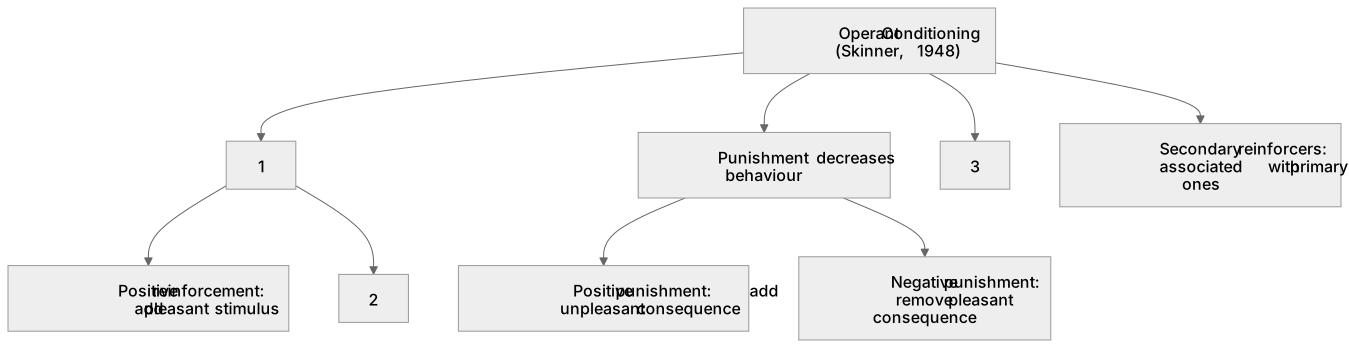
Learning theories explain criminality as acquired behaviour. Skinner's Operant Conditioning suggests consequences shape actions. Positive reinforcement (gaining stolen money) and negative reinforcement (escaping threats) increase crime. Positive punishment (fines) and negative punishment (losing liberty) decrease it. Primary reinforcers satisfy basic needs; secondary reinforcers (money) buy them. Bandura's Social Learning Theory posits crime is learnt via observational learning. Individuals identify with role models and model their behaviour. Seeing a model rewarded acts as vicarious reinforcement, encouraging imitation. Strengths include practical applications like token economies, but weaknesses include ignoring biological factors.
What earns the marks
- Define positive reinforcement as adding a pleasant stimulus to increase behaviour, and negative reinforcement as removing an unpleasant stimulus.
- Distinguish between positive punishment (adding an unpleasant consequence) and negative punishment (removing a pleasant consequence).
- Explain that primary reinforcers satisfy biological needs, whereas secondary reinforcers are associated with primary ones.
- Describe how observational learning occurs when an individual identifies with a role model and imitates their modelled behaviour.
- Evaluate the theories by discussing strengths, such as explaining environmental influences, and weaknesses, such as neglecting genetic factors.
Common mistakes and how to put them right
Confusing negative reinforcement with punishment.
Put it right: Negative reinforcement increases a behaviour by removing something unpleasant, whereas punishment decreases a behaviour.
Using 'modelling' and 'imitation' interchangeably without context.
Put it right: Modelling refers to the role model demonstrating the behaviour, which the observer then imitates.
Assuming primary reinforcers are always more powerful than secondary ones.
Put it right: Secondary reinforcers like money can be highly motivating because they provide access to multiple primary reinforcers.
Exam tips
- Use concrete examples of criminal behaviour, such as theft or vandalism, when explaining operant conditioning concepts.
- Clearly link vicarious reinforcement to the observer seeing the role model's consequences, not their own.
- When evaluating, contrast learning theories with biological explanations to highlight their failure to account for innate factors.
Try the lesson
The start of the Criminal psychology: 6.1.1 Understand learning theories as an explanation of criminality, including strengths and weaknesses of each theory: • Operant Conditioning (Skinner, 1948), to include a. positive reinforcement b. negative reinforcement c. positive punishment d. negative punishment e. primary reinforcers f. secondary reinforcers • Social Learning Theory (Bandura, 1977), to include g. role models h. modelling i. identification j. observational learning k. vicarious reinforcement lesson, made from checked teaching notes for this specification point.
Have a go first
Which of the following best describes vicarious reinforcement in the context of Social Learning Theory?
Listen
Learning theories explain criminality as acquired behaviour. Skinner's Operant Conditioning suggests consequences shape actions. Positive reinforcement (gaining stolen money) and negative reinforcement (escaping threats) increase crime. Positive punishment (fines) and negative punishment (losing liberty) decrease it. Primary reinforcers satisfy basic needs; secondary reinforcers (money) buy them. Bandura's Social Learning Theory posits crime is learnt via observational learning. Individuals identify with role models and model their behaviour. Seeing a model rewarded acts as vicarious reinforcement, encouraging imitation. Strengths include practical applications like token economies, but weaknesses include ignoring biological factors. A strong answer earns marks for these points. Define positive reinforcement as adding a pleasant stimulus to increase behaviour, and negative reinforcement as removing an unpleasant stimulus. Distinguish between positive punishment (adding an unpleasant consequence) and negative punishment (removing a pleasant consequence). Explain that primary reinforcers satisfy biological needs, whereas secondary reinforcers are associated with primary ones. Describe how observational learning occurs when an individual identifies with a role model and imitates their modelled behaviour. A common slip: Confusing negative reinforcement with punishment. Instead, Negative reinforcement increases a behaviour by removing something unpleasant, whereas punishment decreases a behaviour. Exam tip: Use concrete examples of criminal behaviour, such as theft or vandalism, when explaining operant conditioning concepts.
See it

Label the diagram
Some boxes have lost their names. Pick the right name for each number.
1Box 1
2Box 2
3Box 3
There is more to this lesson
The full lesson goes on to check your understanding and help you earn the marks. Create a free account to carry on, with your progress saved.
A week of Premium from your first lesson · Then the free plan continues · No card, no charge
Test your understanding of Criminal psychology: 6.1.1 Understand learning theories as an explanation of criminality, including strengths and weaknesses of each theory: • Operant Conditioning (Skinner, 1948), to include a. positive reinforcement b. negative reinforcement c. positive punishment d. negative punishment e. primary reinforcers f. secondary reinforcers • Social Learning Theory (Bandura, 1977), to include g. role models h. modelling i. identification j. observational learning k. vicarious reinforcement
Active recall beats re-reading. Take an instant quiz now to test what you’ve learned and lock it into long-term memory.
A week of Premium from your first lesson · Then the free plan continues · No card, no charge